Here we go, the first full day. I freshen up before heading outside. I quickly walk up to the 5th floor where the social area is, but there’s not much happening there. It’s not a hostel with groups or lots of social activities. Actually, I like it. I head out on my own, no plan.
I’m staying in Colaba, a southern peninsula of Mumbai. Since I grew up by the sea, I always feel the urge to walk to the coast. I haven’t seen it here yet and I want to check how I can get there.
I step onto the street and the chaos begins: deafening beeps from buses, scooters, cars, taxis. Traffic has just one rule which is, no rules. The streets and shops are tiny, really tiny. Sandcement, bricks, plumbing, clothing, a barbershop, a supermarket—you find it all within 50 meters all next to each other. Shops aren’t bigger than 8m²; 2 wide and 4 deep is the norm. Your senses are constantly triggered—one moment you smell incense or a food stall, the next a dirty trash bin. Then a familiar smell: a cow, right in the middle of the street, between two bus stops… You keep being amazed. Extremes everywhere—this is Mumbai after just 15 minutes of walking.
I walk south, and it gets quieter, which is nice. Then I realize this is exactly what I’d been told: contrasts. You can only feel it. I do a lot by instinct—I don’t just look, I observe. Often I get warm smiles back, especially when I watch with patience what people are doing, from cutting coconuts to arranging flowers. When you give attention, something happens. And ofcourse, think about who’s giving them attention? A tall Dutch lanky guy, nearly 2 meters—definitely not an everyday sight here…
There are many military stations and a navy base with fenced-off gates. I end up walking the wrong way, lost in thoughts of my friend Jessie, who served in the army. On the map I also spot a US Golf Club, also behind gates… No entry for me.
So I turn back. I hear a school and sneak inside, where I’m warmly welcomed by a woman. Soon, dozens of beautiful dark eyes are fixed on me—nothing beats those cheeky eyes when staring at you. Quickly, I gesture to them to look back at the teacher, who’s drawing a math exercise on the board.
On the way here, I’d passed a busy bus station, and checking the map I see a slum nearby. My gut tells me to go in. But first, some food. I stop to attentively observe a man rolling dough balls and baking pita bread right in front of me, full of passion. The place itself is nothing—a kind of football dressing room with tables. Nothing fancy, just local Mumbai slum foodstation you would walk by 11/10 times.
I step in, I fold myself between a table, and people look surprised that I chose this place. Four workers come in too, and soon the room is almost full. I get a delicious plate of fresh curry, two scoops of rice, a bottle of water, and two pita breads—all for €1. I enjoy it, not just the food, but also watching my man across from me mixing everything with his hands and eating with delight and smack while eating.
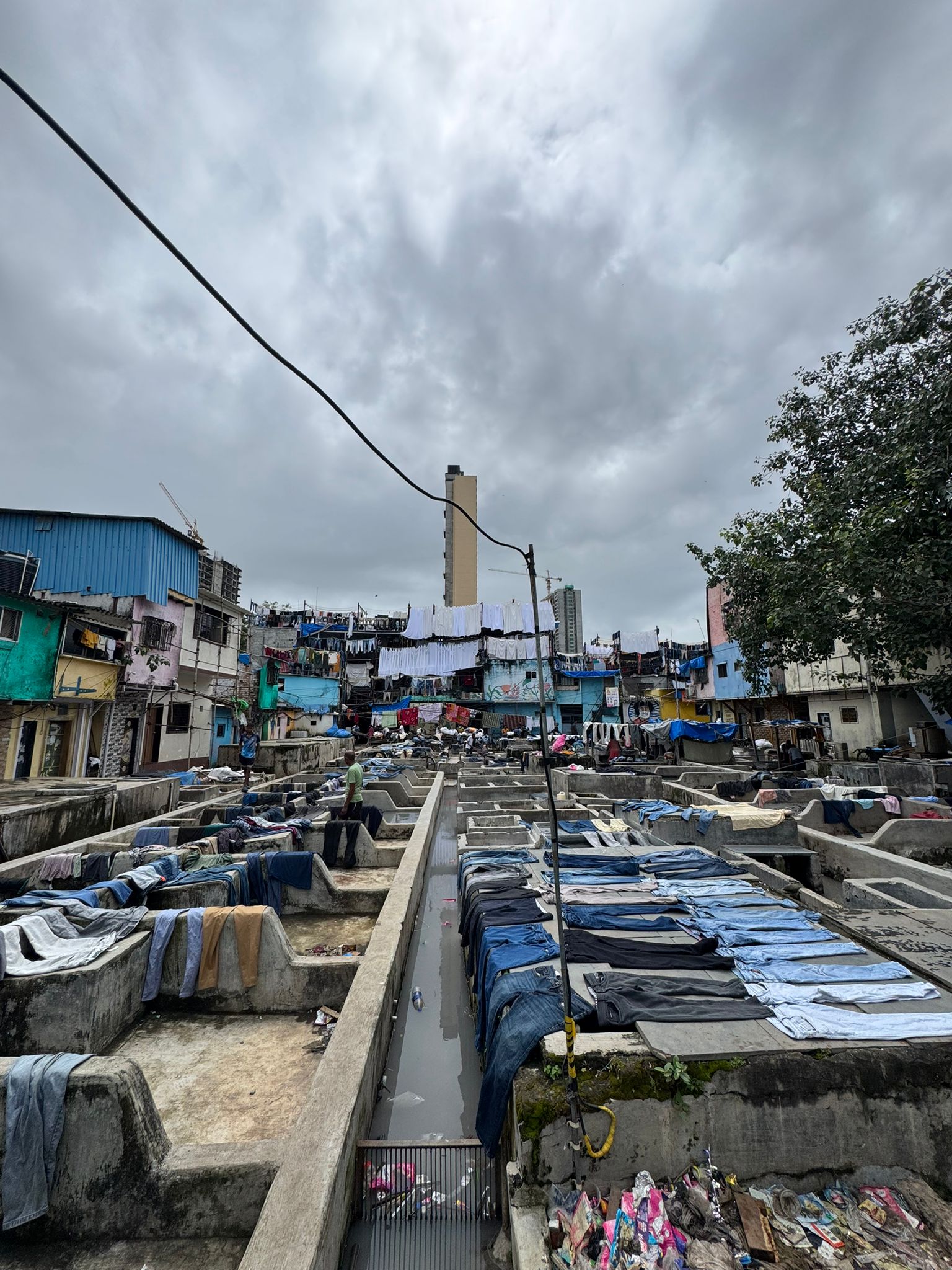
Then I turn the corner into the slum. Narrow paths, twists and turns, and surprisingly—an amazing smell. Laundry! Everywhere: pants, bedsheets, clothes, towels. Bags of laundry arrive by handcart. My first question that strikes me: how do they know what belongs to who? That question will be answered. A little boy named Sunit approaches me and explains everything. The laundry is for hotels, and each family has a responsibility—pants get numbered on the inside, one dries, another folds, another washes. Soon Sunit takes me up to the rooftop. No cocktail included, but I climb sheet metal roofs like I’m in a movie and finally reach the fourth floor with a view of the washing slum. He shows me the machines, the mechanic, the kindergarten, the barber, the food stall. Their whole life is just this slum, and this is all they know. He even tells me where the water/shore is that I’d been looking for. I give some tip my friend Sunit for the tour and move on.
By surprise, I end up in an alley and head toward the water, smiling along, and after a few hundred meters I reach it. There’s water, yes, and a view of Mumbai, but mostly it’s a dump of trash with a pier, sewage, and a view of the sea toward another part of Mumbai. Not romantic… But then I notice something else: a Western couple with a guide. The guide looks surprised and asks what I’m doing and how I got here. “I have no idea,” I say, “just instinct.” Then he asks if I’ve read the book Shantaram. A 933-page thriller set in Mumbai. Proudly, I answer “yes.” When I told people in Amsterdam about my trip to Mumbai/India, this book was recommended to me. To give him a fuller answer, I explain that I finished the last pages only three days ago—I wanted to finish the book before coming here.
The guide and the Irish couple look at me in amazement. I’m amazed at myself too, but even more when the guide, Kumar, tells me he’s the nephew of one of the characters in the book. The book is about an Australian hippie who builds a life here and ends up in a gang. A fantastic story. At first, I judge Kumar on his cover when he tells he is the nephew of one of the characters. This doubt fades when he invites me to join their tour. We talk about the book, he shows me documentaries, old photos of the main character—I go from one surprise to another, and the judgement was based on nothing. This is travel in its purest form. This is a memory I’ll never forget.
I join the tour and the four of us continue. It starts to rain, so we head to his smokehouse. Up a staircase to the first floor we enter. Just one bed, a pile of junk, a chair, and a cage with 40 pigeons. There I am—with a beer, the Irish couple, Kumar, and his friends smoking and talking about life. Kumar has a beautiful vision on life and tells about people treat each other here. A takeaway: “don’t hate the person, judge the mistake only.” He is street-smart and his experience is impressive. He also tells about arranged marriages, which are still common here. I’d noticed being here that about 70–80% of people on the streets are men. Kumar explains that in some cases babies are already promised for marriage before they’re even born. That hits hard. I feel beyond privileged as a man. With a beer, a rat darting across the room, and a scene I’ll never forget, we all know this is a special moment.
We continue the tour to the houses of characters from the book, drive past a prison, the Pakistani neighborhood, and the red-light district. Things I’d never have seen otherwise. A reward after working through all 933 pages last summer.
We finish at the same restaurant where I’d eaten the night before, and together with Connor and Ellen we enjoy the evening. Later, I walk over to the Taj Mahal Hotel for a beer. It’s all grandeur and luxury, but honestly, the marble lobby doesn’t do much to me. Every celebrity has been here: Dalai Lama, Obama, Bush, Clinton, John Lennon, Cate Blanchett, Queen Elizabeth, William & Kate, Christian Louboutin, Jacques Chirac… and yes, you guess it right, Stan The Man has now set foot here too.
Strolling back home along the boulevard, my thoughts wander. Slowly, it sinks in—this is a memory for life. Grateful!


2 Responses
Wat een avontuur, ga het boek gelijk aanschaffen👍😀😘
❤️trots op jou