Varanasi. I’ll get straight to the point, this is an intense blog about what I experienced here.
Arriving in the evening, I already struggled a bit to adjust to the chaos of this city. Understandable, after spending a long time in peaceful coastal areas. Varanasi is known as a pilgrimage city, located on the banks of the Ganges River. The city is thousands of years old and deeply rooted in Hindu tradition. It’s one of the most sacred places associated with Lord Shiva, one of the most revered deities in the world.
As I start walking, I head from my hotel toward the Ghat, the steps that lead down to the riverbank of the Ganges. My day begins innocently enough. I buy some bananas for breakfast and wander through the narrow streets, passing a small school with children waving happily. I make my way to the Dashashwamedh Ghat.
When I arrive, it’s busy, not overwhelming, luckily, so I walk around and take in everything happening around me. From rituals and offerings to people washing their clothes, I see it all, and I notice how open I feel to all these impressions.
A man approaches me and says, “This is a holy river, my friend. You can wash your bad karma off here.” Of course, I’ve heard that before. And yet, standing here at the Ganges feels different. I decide to follow the sacred number 9 and carefully wash my face 9 times with my hands. You can’t come all this way and not take part in a ritual of the river — big or small, there is something for everyone. The man stays near me, joking around. His name is Rajan. Funny enough, I already have a friend named Rajan back in Amsterdam. But for this morning here in Varanasi, this Rajan is my friend.
After cleansing myself and walking around the Ghat, I sit down with him for a chai. We laugh a bit, and he tells me more about Shiva and the Hindu faith — the four mothers they worship: Mama Ganga (the Ganges River), Mother Earth, Mother Cow, and Mother Shiva. I told him I only worship one mother — Mama Anita. Well, maybe two now, after cleansing myself in the Ganga.
Rajan and I talk about karma, and soon he tells me that I have good karma. So, my washing was just a precaution in case any bad karma comes my way in the future. It’s quite special to hear that — and even more so when, symbolically, a butterfly flies right between us. I tell Rajan that this is a sign that we both have good karma, and he laughs. I truly believe in this saying: “If you keep working on your garden, the butterflies will come.”
A little later, Rajan tells me where to go next and warns me about the tourist traps. I head to the Manikarnika Ghat and yes, this is where things get extreme. This is the place where bodies are cremated on open fires, right beside the Ganges, to allow souls to go straight to afterlife as quickly as possible.
When I arrive, I’m stunned. Absolutely stunned. You can’t prepare for this. All around are funeral pyres at different stages of burning. I’m standing so close that I feel the heat of the fire on my face. Roughly every ten minutes, another body arrives — wrapped in simple decorations and carried on bamboo poles. It’s briefly dipped in the Ganges for the last time, then laid out to dry. The woodpile is built up, and then the body is placed on the woodpile.
What strikes me most is that there’s no sadness. The relatives carry the body with calmness and seem to embrace death in an open, accepting way. It’s deeply fascinating. The process feels peaceful — and traditionally, no women are present, as it’s believed emotions should remain contained with them more.
At one point, I see a body whose face is still visible, still carrying some color of life. It’s tradition to cremate the dead as soon as possible, and witnessing this so closely fills me with astonishment, wonder, respect, and humility. The sizzling sound of moisture as the body gets fire goes through me. I realize this is an image that will stay with me forever. It’s bizarre, unreal, and yet, the longer you stay, the more peaceful it feels.
Because of the amount of wood used — about 150 kg per person — the only smell is that of burning wood and fire. To secure one’s status in the afterlife, families can choose from different types of wood, depending on their means. People here work around the clock to keep these fires burning. And yes — when a pile collapses and bones fall off, young men use bamboo tongs to place them back onto the fire. “Tell me, what do you do for a living?”
I watch for hours, realizing again that this is the closest I’ll ever come to death. I’m not emotionally overwhelmed, thankfully. And to think — back in 2017, when my own grandfather passed away, I chose not to look at him in his coffin. I wasn’t ready then. Now, standing here, I feel calm, confident, and aware of how much I’ve grown in understanding life itself.
It amazes me to see the almost assembly-line rhythm of these cremations — going on 24/7, around 200 bodies a day sent to the afterlife. Out of respect for the deceased, their families, and their religion, I decided NOT to take photos.
This vision is graved in my mind, a personal memory. These words are only my experience. If you want to truly understand, there’s only one way: stand there yourself. This memory has deepened my understanding of both death and life. An unparalleled experience — one that can only be described as loving acceptance of death.
Afterward, I get a small tour, and ashes from the eternal Shiva fire are gently placed on my forehead. From this moment, I am blessed with a memory that has enriched me deeply.
Writing about this days later makes me realize — this isn’t for everyone. But I stood there, fully alive.
After nearly three hours, I continue to the sacred Shiva temple. Getting a foreign ticket I see the long lines of people waiting to touch the holy stone of Shiva. It’s like a Hindu version of Mecca — strict rules, dense crowds, people pressing forward just to get their brief moment of connection.
You also see the other side of faith here — large sums of money, offerings, gift shops, even bank terminals around the temple. There must be a fortune circulating here, knowing this devotion never stops. I wander around a bit and end my day with the evening ceremony at Dashashwamedh Ghat.
There’s Rajan again. “Amsterdam, hello mister! Go, go — have a seat wherever you want!” he calls out. With live chanting, rituals, and a Hindu tilak placed on my forehead after a small fire donation, I end the day in style.
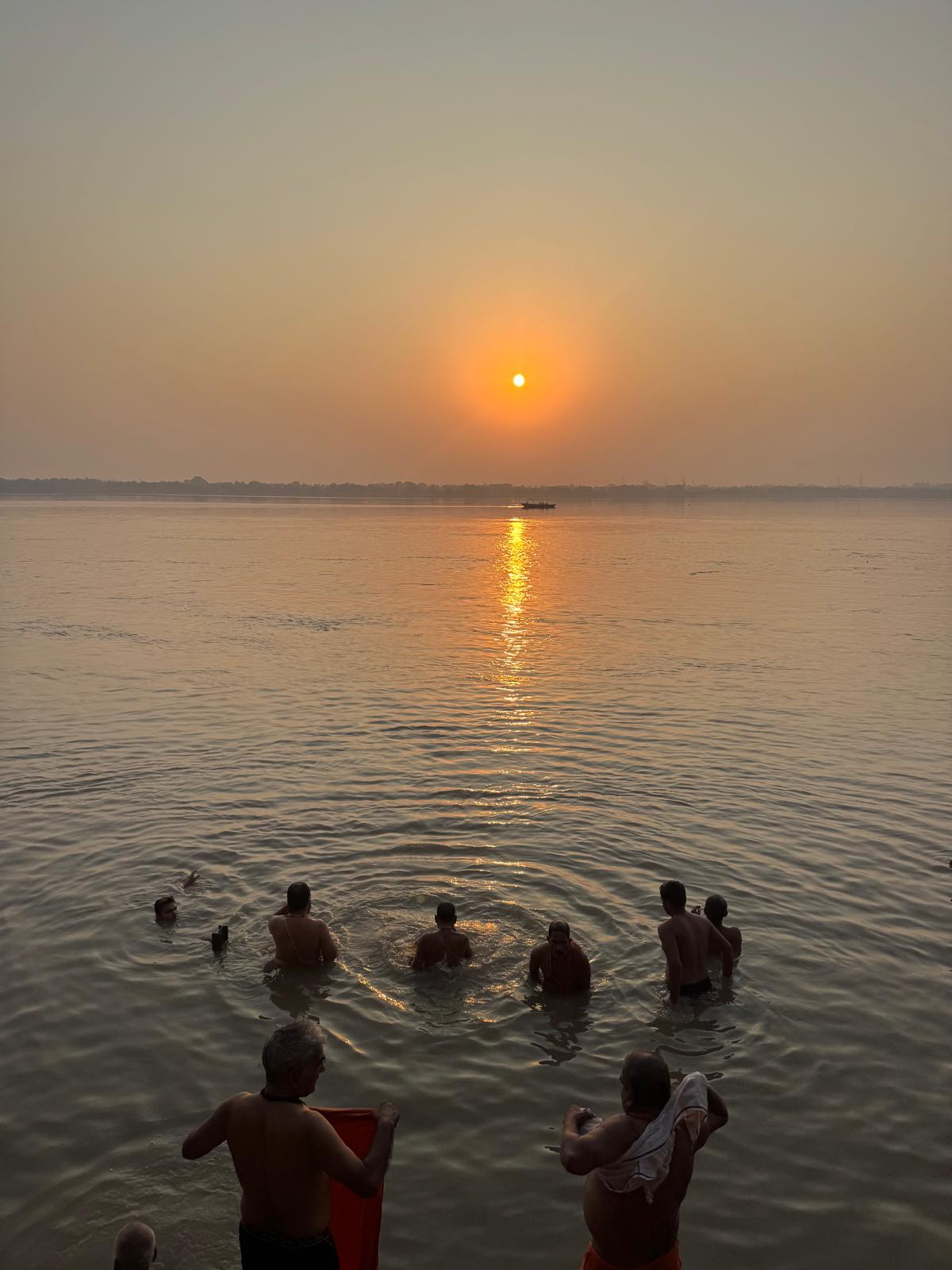
The next morning, I wake up early — very early — for the sunrise ceremony at Assi Ghat. Beautiful rituals and an even more beautiful sunrise over the Ganges create breathtaking scenes. It’s incredible, and then you truly understand the magic — why so many people come here. The serenity as the sun rises slowly over the Ganges makes you realize this has been happening for centuries in this sacred place.
After such an early start, I go for breakfast. But I’m not eating alone — a cow sticks its head right next to me, expecting its share of breakfast from this bakery. Wonderful — so typically India.
Tired from all the walking, I take a Riksja back to my hotel. Sitting in the back, I notice the driver can barely reach the pedals. I decide to have some fun. “Stop here, stop here,” I say. He parks the rickshaw, and we switch places — now he’s sitting in the passenger seat, and I’m pedaling through the busy streets of Varanasi, my little 1,65m rickshaw driver sitting behind me, smiling from ear to ear. You really do have to make something of life yourself, I realize.
I’ve seen the highlights of Varanasi, I decide for myself. You could easily stay here for days, but I move on — taking the train to Lucknow. As the train rolls farther away, I can feel my body processing the intensity of the experience. Tired but fulfilled, I’ve added something immense to my journey. I sleep well, at peace.
Dear readers: embrace death, and you will live more.
Namasté 🙏🏼


No responses yet