Well… after climbing that mountain, good luck trying to ‘top’ that for the rest of the trip. That was obviously never going to happen, so I quickly accepted that thought and kept on trekking. I still had my mission to complete: my six checkpoints above 5,000 meters. That eventually turned into one at 6,000 and five above 5,000.
My next peak, once I’d recovered from my stomach bug, was Kala Patthar. 5,545 meters. A piece of cake at this point, and after just an hour and a half I was standing on the summit at sunrise. I practically flew up and down the mountain, full of energy after a rest day.
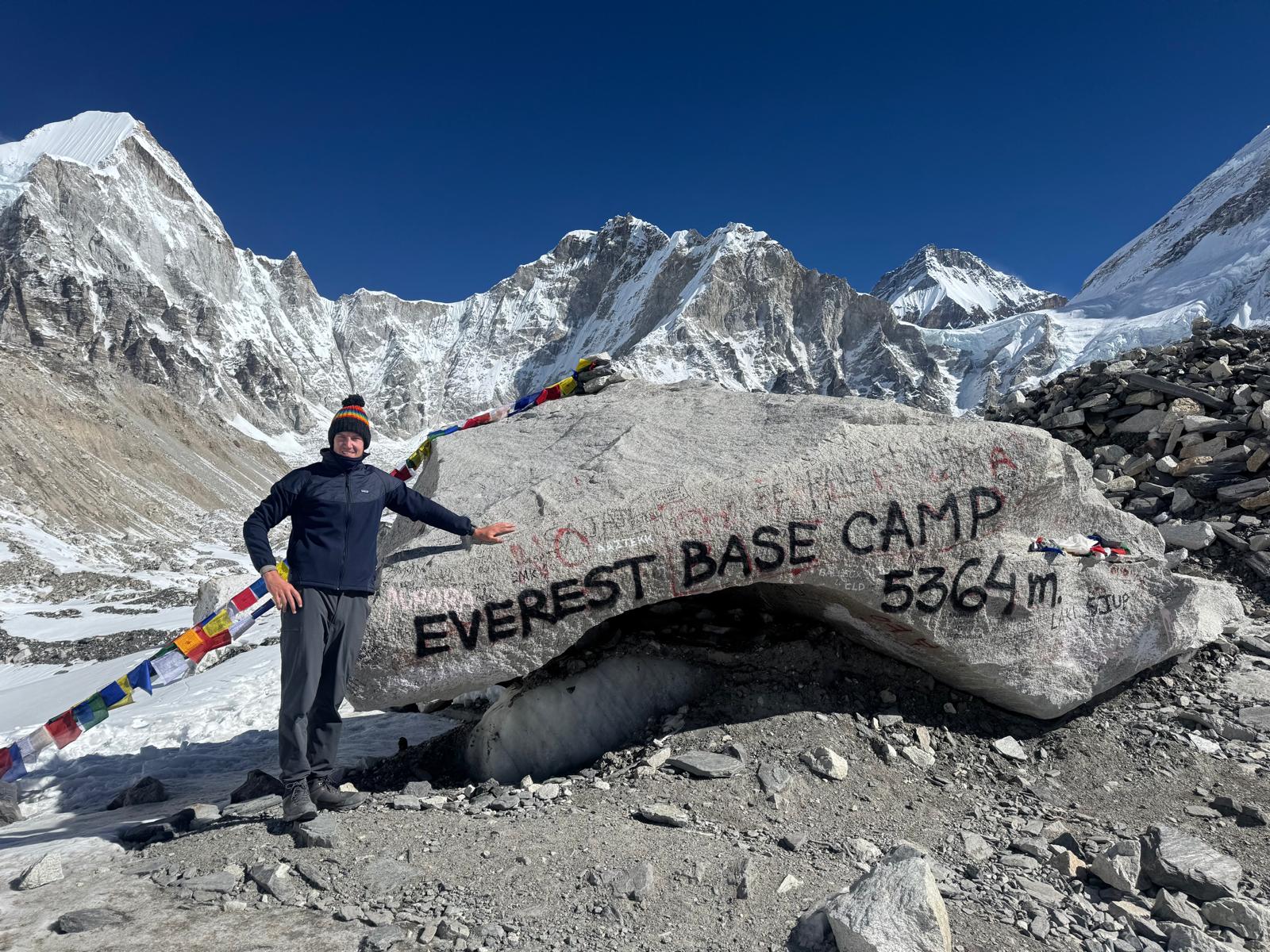
Since I had stayed indoors the previous afternoon, the next day became extra a long one as I had to squeeze in the route from yesterday afternoon. Alarm at 4:30, summit Kala Patthar by 6:00, enjoy sunrise and head down for breakfast, quick rest, and 8:30 I was on my way to Everest Base Camp. Luckily it was quiet to EBC —everyone else had planned to be there the day before as soon as flights had resumed, so the trail had been packed. For me, just a handful of people. It’s not Everest climbing season, so no tents at Base Camp—just the legendary rock and that classic photo. A memory I share with Harbinder and the Smith Family, who I met earlier and who definitely helped tip the scales for me to go for it. Two 5,000m+ points in one morning. Not bad at all.
After that, I still had a five-hour hike ahead of me. By the time I arrived, I was absolutely done for—felt like I’d stuffed three days into one. I stumbled into the lodge, muttered some noises that apparently counted as a food order, ate, and crawled straight into bed. At 18:45 I was lying somewhere—I honestly didn’t even know the name of the place. Some days are just like that. I slept until 5:30 and then it was time for another long day.
Cho La Pass—a monster of a trek up to 5,420 meters. Because it’s a pass into another valley, the approach is long, and the last stretch is brutally steep. I climbed slowly and steadily. At the top it was pretty busy, since people ascend from both sides. At the summit, I saw a sherpa casually smoking a cigarette at 5,420 meters and instantly thought of my brother Jelle who likes a smoke. I’m not planning to dedicate every peak to a family member, but this one made me smile and gave me a little boost thinking of my little brother.
The previous days—with the summit and now three 5,000m+ points—had taken a toll. I felt the physical burn. Eating enough was becoming tough, and without fuel you simply can’t keep the machine running. The final stretch to the next village felt endless, and there was no shop or place to get food on the pass itself. I was running on fumes. I asked my sherpa how long it would be. “Forty minutes,” he said. Because I was destroyed it took me an hour and twenty minutes. When I finally reached the first teahouse, all I could do was eat.
Thankfully, I perked up when the South African couple walked in—also completely wiped out and tired. Good to see familiar faces, my travel buddies at this point.
The next day was an easy one: heading to Gokyo via the Ngozumpa Glacier, the longest in the Himalayas at 36 km. A totally different world—massive, eerie, cracked, constantly shifting. Nature creates and it is amazing to cross this glacier. Because of yearly snow and shifting ice, the route changes all the time is what my sherpa tells me. Just a short two-and-a-half-hour hike, rewarded with beautiful lakes and sweeping views over the Gokyo valley.
We arrived in the early morning, and while sitting in a restaurant I met Linton and Jack—two Brits. Their girlfriends were completely depleted, so I made plans with the guys to climb Gokyo Ri, 5,350 meters. We caught a stunning sunset where Mt. Everest was the last peak glowing in the fading light. Pure magic—nature doing something incredibly simple yet unbelievably impressive. A few great photos and a memory I’ll hold onto with Jack and Linton.
The next day for the balance, my energy drained again. I was wrecked after a horrible night sleeping next to a staircase. The rooms are so tiny you feel like you’re sleeping inside one of those wooden wine gift boxes—and at -20°C, with the sounds of the night seeping in, it’s… well, no picnic. A reminder of how important the basics are. I decide to take rest in the afternoon.
The day after that, it would surprise you…another long day on the program, with the final climb over Renjo La Pass. You might wonder: is hiking the only thing you do in Nepal? Honestly—yes. Sometimes you have a shallow conversation with someone on the trail, and sometimes you meet genuinely lovely people who brighten your day. It’s humbling to walk in an environment where humans are tiny and powerless against nature. Every evening, after dinner, you crawl straight into bed—maybe with a little snack as your personal “peak of the day.” The mix of effort and rest is everything. It’s not about speed, and it’s not about racing from A to B. It’s about the journey. Take your time. I definitely rushed myself unnecessarily on some days, only to realize later that slow and steady was the way to go.
While recovering from my stomach bug in a teahouse, I saw a sticker that said: “It’s okay not to be okay.” That one stuck with me as I approached this last pass.
In Gokyo, I bought a brownie that was dry as the desert, but somehow tasted amazing when I reached the top of Renjo La. At 5,360 meters, I realized I’d completed all my peaks. Proud of myself—no injuries, no sickness, just persistence and stubbornness. Quite an achievement, especially with Lobuche Peak in the mix. An experience for life.
My little hall-of-fame list, symbolically dedicated to myself, my family, and to all of you:
• 6,119 / Lobuche East Peak
• 5,545 / Kala Patthar
• 5,420 / Cho La Pass
• 5,364 / Everest Base Camp
• 5,360 / Renjo La Pass
• 5,357 / Gokyo Ri
I do love my numbers—hence this list. I’m proud. Knowing that I’m capable of this kind of physical and mental push in such a short time leaves me hungry for more challenges. Who knows—maybe I’ll come back for another mountain. But not yet. For now, I’m embracing it with gratitude: perfect conditions, no illnesses, no injuries, and all of it done purely under my own power. I’ll savour this one, and I’m not jumping head-first into a new hobby or chasing the next big thing. Just enjoy the pleasure of what I’ve done.
Arriving back in Namche Bazaar felt like coming home—and oh boy, did it feel like coming home. After ten days, I finally took a shower. Absolute luxury. I swear I stood under that warm water for half an hour, realizing how much of a privilege it is to just turn a tap and have hot water come out—something I’d never truly appreciated before.
I met up with Arthur and Acacia, my two sweethearts from along the way, and drank a beer. Said goodbye with a long big hug. They were definitely part of my journey—and sometimes all you need on a rough day is a familiar face or a shared laugh.
The final day: hiking from Namche Bazaar to Lukla, the airport village. A big descent from 3,400 down to 2,600 meters. Over 20 km up and down, finishing in style with over 3,000 calories burned after 7.5 hours. In Lukla, I celebrated with a Chocomel and Baileys. When I spilled a splash on my windbreaker, I couldn’t have cared less. I was here—and I’d bloody done it. What an experience. This one’s way up there in the rankings.
The next day: the notorious flight back from Lukla—which, honestly, didn’t even feel scary anymore. Arriving in Kathmandu, I suddenly felt how hungry and drained I was. At the hotel I looked in the mirror and could see how much muscle I’d lost. I ate like crazy, didn’t overthink anything—just devoured whatever was in front of me—and focused on recovery and rest before heading to my next destination.
Nepal, I’m endlessly grateful for this high point!


No responses yet